
The World Under Attack: When Everything and Nothing Converge
In recent days, we have witnessed global corporations suffer unprecedented cyberattacks, triggering massive digital blackouts that affect millions of users and customers across the planet.
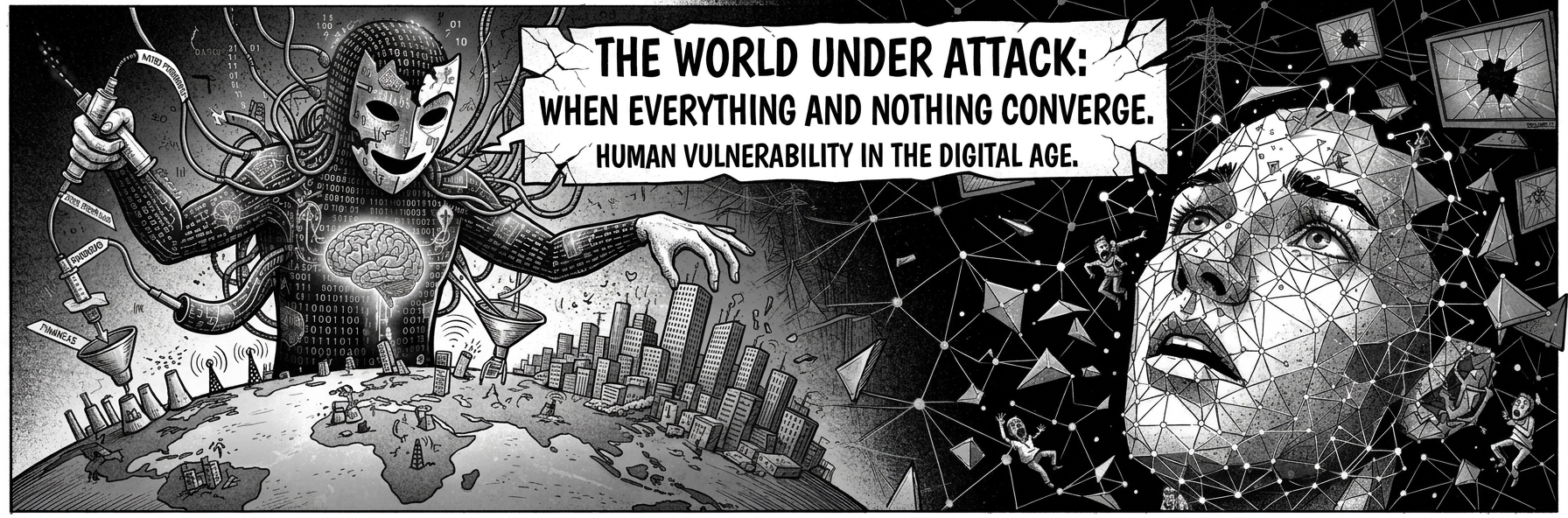
These types of incidents—which no longer distinguish between industries, company sizes, or market niches—have become alarmingly commonplace. For the everyday citizen, the scene is unsettling: watching the very platforms they trust, rely on, and even defend daily brought to their knees, exposed and out of service.
For businesses, this landscape represents a painful and forced awakening. Cybersecurity is no longer what it was just a few months ago; purely reactive defense models have become obsolete. By the time an organization responds, the damage has already been done and the attacker's strategic objective has been achieved.
The Bigger Picture: Beyond Financial Gain
Every attack follows a highly precise architecture of intent. When smartphone manufacturers are breached, the target is not merely the device, but the map of personal data and backups, opening the door to large-scale extortion schemes. When the banking sector is in the crosshairs, the motive is obvious: money and financial flow.
Yet the chessboard is far wider. When we factor in attacks on airlines, power grids, and critical infrastructure, a deeply troubling scenario begins to take shape. By piecing this stolen information together, threat actors could map out geolocation data, consumption habits, finances, and home addresses on a global scale: the systematic construction of the largest human database ever created.
This pulls us straight into the cinematic dystopias of the 1990s. It forces us to reconsider how much information we leave exposed and to what extent our service providers are truly capable of safeguarding what we consider most intimate and personal.
The Invisible Factor: When Artificial Intelligence Takes Over the Attack
If this scenario is already unnerving, the arrival of Artificial Intelligence on the cybersecurity battlefield changes the rules of the game for good. We are no longer talking solely about groups of hackers working manually behind a screen; we are witnessing the birth of autonomous threats capable of learning, adapting, and executing offensives at an inhuman speed.
AI has evolved from a simple tool into a force multiplier. For attackers, it means automating vulnerability reconnaissance on a global scale. What used to take a team of experts weeks of meticulous analysis, an algorithm now uncovers in a matter of seconds, spotting imperceptible flaws within the most complex infrastructures.
At the same time, the deepest impact unfolds on a psychological and human level. Social engineering has evolved toward surgical precision: with generative models, poorly written phishing emails are a thing of the past. Today, we face hyper-personalized messages and real-time audio and video deepfakes that mimic voices and faces with uncanny accuracy. AI is eroding the most fundamental pillar of our digital interaction: the certainty of knowing who is on the other side.
Within that vast human database built from massive data breaches, Artificial Intelligence acts as the brain capable of making sense of the chaos. Advanced algorithms cross-reference millions of records in minutes to predict behavior, pinpoint weaknesses in key individuals, and deploy malware that mutates its code in real time to remain invisible to traditional defensive radars.
The Uncomfortable Questions
Confronted with this algorithmic arms race, the defining question is not merely how vulnerable we are today, but how far this exposure will reach:
- What will happen when these automated offensives directly target intelligence agencies and state law enforcement bodies?
- What will happen when our countries' lawmakers, representatives, and regulators see their private information—or the ongoing investigations they oversee—exposed to the public?
Are we truly on the threshold of a new era of technological emancipation, or are we simply learning to inhabit a digital ecosystem where machines evolve far faster than our own ability to protect ourselves and regulate them?